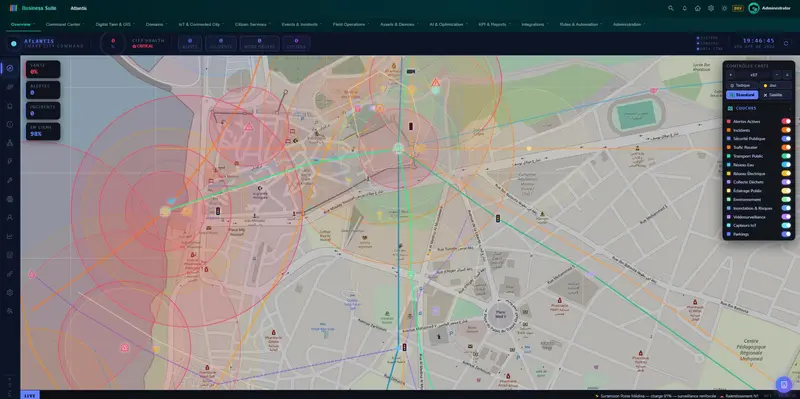
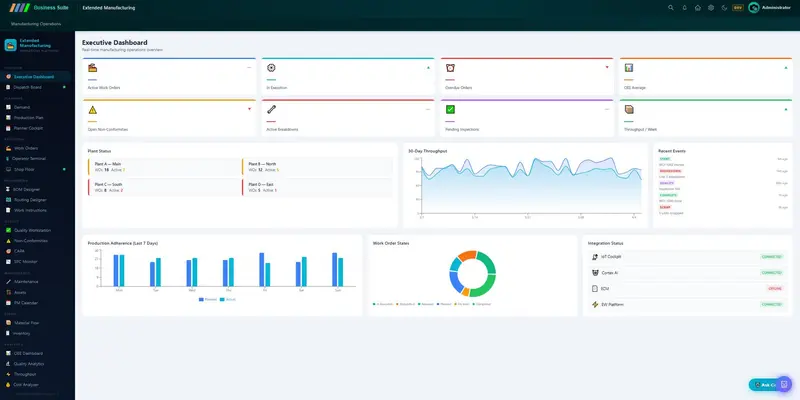
The $50 Billion Problem Nobody Wants to Talk About
In a modern manufacturing facility, a single hour of unplanned downtime on a critical production line can cost anywhere from $20,000 to $2 million — depending on the industry, the asset class, and the cascading supply chain effects. Multiply that by the frequency of unexpected failures across a multi-plant enterprise, add the secondary costs of emergency spare parts procurement, overtime labour, scrap rework, missed customer commitments, and regulatory non-compliance, and the true economic weight of poor maintenance management becomes staggering. The Aberdeen Group reports that the average manufacturer experiences 800 hours of downtime per year across its asset base. IDC estimates that unplanned downtime costs Fortune Global 500 manufacturers an average of $532,000 per hour. Gartner's analysis of industrial enterprises consistently shows that maintenance costs represent 15–40% of total production costs — yet 70% of those costs are incurred reactively, in response to failures that modern predictive technology could have anticipated days, weeks, or even months in advance. The technology to solve this problem has existed in fragmented form for years. Vibration sensors, thermal cameras, oil analysis labs, SCADA historians, and ML anomaly detectors have all been available. But stitching them together into a coherent, integrated maintenance intelligence platform — one that spans the full lifecycle from work request intake to FMEA-driven root cause analysis, from real-time IoT telemetry to AI-generated intervention windows, from spare parts reservation to vendor SLA compliance tracking — has remained beyond the reach of every enterprise software vendor on the market. Business Suite Extended Maintenance ends that era. Permanently.
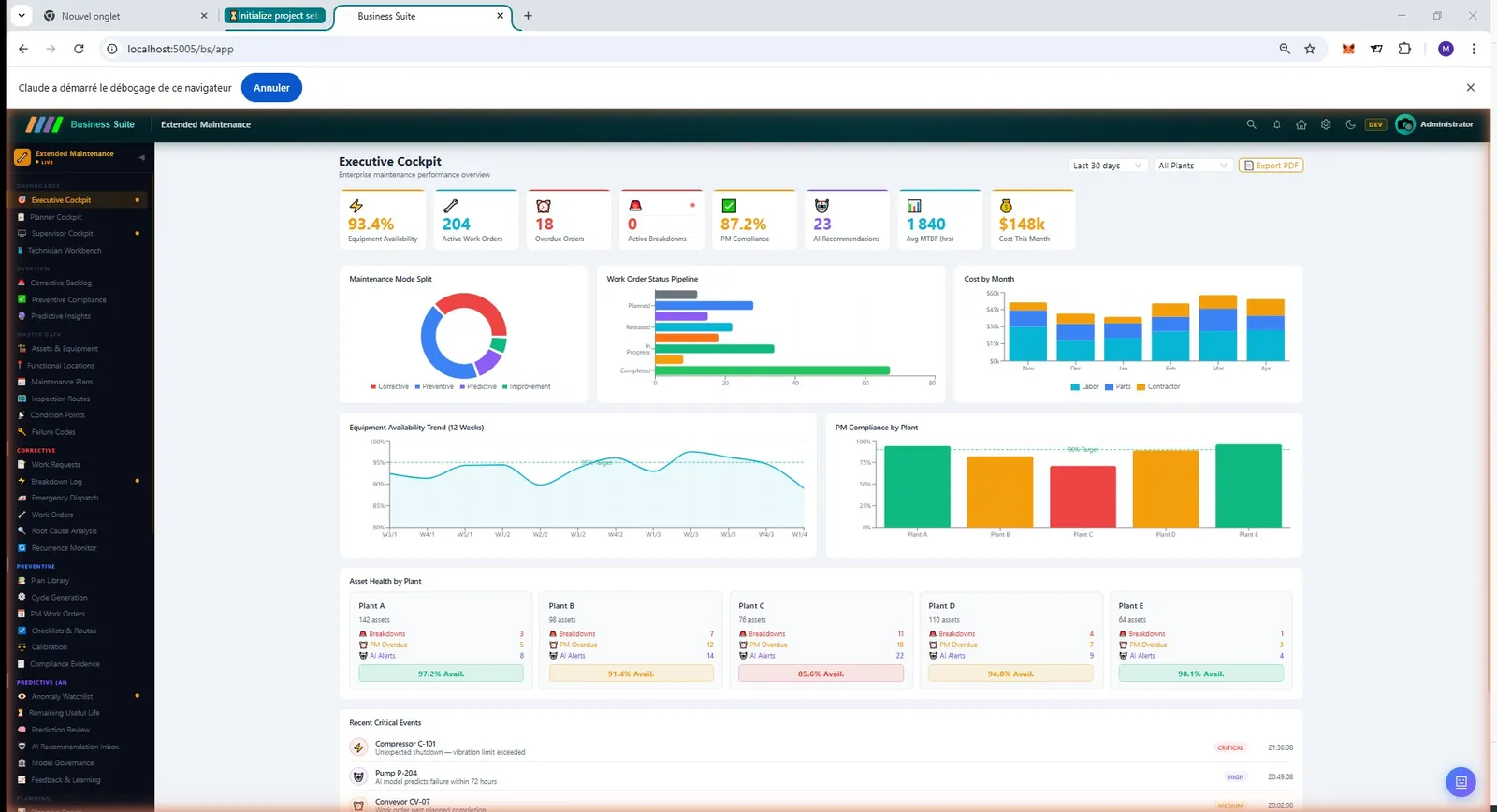
The Three Pillars of Industrial Maintenance: A Definitive Technical Framework
Before understanding what makes Business Suite Extended Maintenance genuinely revolutionary, it is essential to precisely define the three maintenance paradigms it masters — because sloppy definitions lead to sloppy strategies, and sloppy strategies lead to the $50 billion problem described above.
Pillar One — Corrective Maintenance: The Discipline of Rapid, Intelligent Response
Corrective maintenance — also called curative or reactive maintenance — is the response to failure that has already occurred. Despite the industry's rightful push toward prevention, corrective maintenance will always be part of the maintenance landscape. Equipment fails unpredictably. Sensors miss edge cases. Even the most sophisticated predictive model operates at probabilistic confidence levels, not certainty. The question is never whether corrective maintenance will occur, but whether your enterprise can respond to it with speed, precision, and systematic learning. Most enterprise CMMS platforms treat corrective maintenance as a simple work order. Business Suite Extended Maintenance treats it as an intelligence event. Every breakdown is captured in a structured Breakdown Log (BDL) with a mandatory failure taxonomy code from a five-category failure classification hierarchy — Mechanical, Electrical, Hydraulic/Pneumatic, Contamination, and Software/Controls. Each category carries a standard root cause template that guides technicians through systematic fault isolation rather than intuition-driven guesswork. The work order lifecycle is governed by an eight-state workflow — Draft → Planned → Approved → Released → Dispatched → In Progress → Completed → Closed — with enforced state transitions that prevent premature closure, unauthorized release, or permit bypass. The Permit to Work (PTW) subsystem is fully integrated: for work classified as LOTO, hot work, confined space entry, electrical isolation, height work, or excavation, the system enforces permit issuance as a pre-condition for work release. No permit, no release. Period. Every corrective event contributes directly to the Reliability Record engine — automatically updating MTBF (Mean Time Between Failures) and MTTR (Mean Time To Repair) calculations in real time. When a corrective work order is closed, the system writes back to the EAM (Enterprise Asset Management) module, updating the asset's health score, condition classification, and lifecycle status. The failure becomes a data point in a growing reliability intelligence corpus — one that Cortex AI mines continuously for pattern recognition and predictive model refinement.
Pillar Two — Preventive Maintenance: The Architecture of Disciplined Proactivity
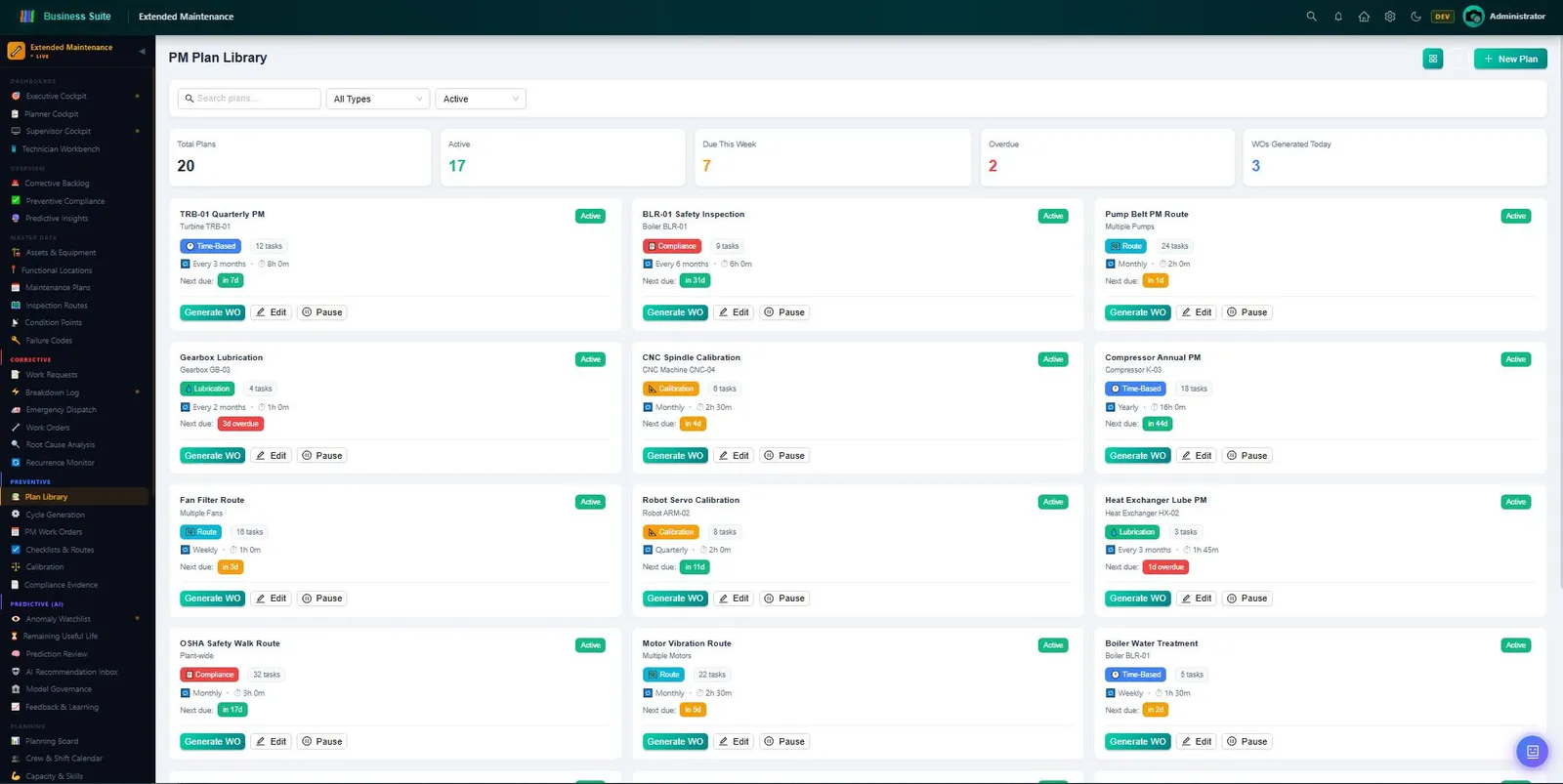
Preventive maintenance is the scheduled, systematic intervention on equipment before failure occurs. It is the foundation of any mature maintenance programme. But here is the problem that most CMMS vendors never honestly acknowledge: poorly designed preventive maintenance programmes are expensive failures. Over-maintenance is real — lubricating a bearing every 500 hours when it needs attention every 2,000 hours wastes labour, spares, and production time. Under-maintenance is equally real. The interval between scheduled tasks is frequently determined by manufacturer recommendations that were written for generic operating conditions, not for the specific thermal, load, and environmental profile of your actual equipment in your actual plant. Business Suite Extended Maintenance addresses this with a maintenance planning engine of extraordinary flexibility. The `maint.plan` model supports eight distinct plan types — time-based intervals, meter-based intervals (hours run, kilometres, production cycles), condition-based triggers, inspection route scheduling, seasonal maintenance cycles, lubrication schedules, calibration programmes, and compliance/statutory inspections. Each plan type has its own scheduling logic, its own frequency configuration (daily through annual, or usage-based), and its own auto-generation rules. The Inspection Route module deserves special attention. Maintenance engineers can define structured inspection tours — sequences of assets to be visited in a defined order, each with specific readings to be captured, with target values, measurement units, and tolerance bands. When the assigned technician executes the route with a mobile device, the system records each measurement, evaluates it against the target, flags out-of-tolerance readings in real time, and automatically generates a corrective work request if a reading falls outside the critical band. This transforms the inspection round from a paper-based ritual into a structured data collection exercise that feeds directly into the condition monitoring and reliability intelligence layers. The PM auto-generation cron runs daily, evaluating every active maintenance plan against its `next_due` date. Plans that are due generate draft work orders automatically, which then flow through the approval and dispatch workflow. Planners see a clean forward schedule; supervisors see a daily work queue; technicians see assigned work orders with full technical content, step-by-step task lists from the plan template, and safety notes embedded at the operation level. Nothing falls through the cracks.
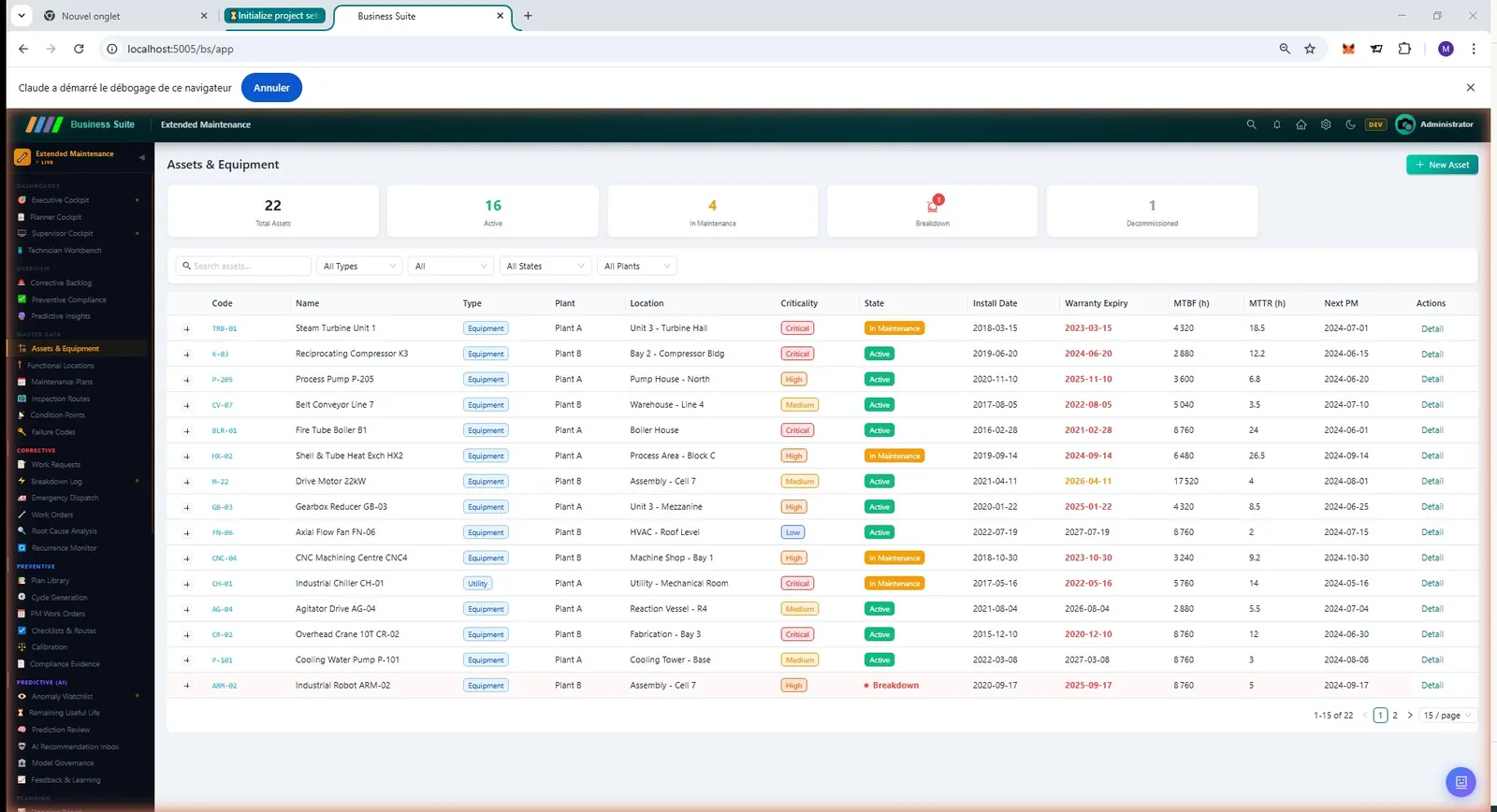
Pillar Three — Predictive Maintenance: Where Physics Meets Machine Intelligence
Predictive maintenance (PdM) is the operational paradigm where physics-based condition indicators, statistical degradation models, and machine learning algorithms converge to predict equipment failure before it occurs — with sufficient lead time to plan and execute targeted intervention, and with sufficient precision to avoid over-maintenance. It is the most economically compelling maintenance strategy available: studies by the U.S. Department of Energy show PdM programmes delivering 8–12% cost savings over preventive maintenance, 25–30% reductions in maintenance costs, 70–75% reductions in equipment breakdowns, and 35–45% reductions in downtime. The technical foundation of predictive maintenance rests on four condition monitoring modalities: vibration analysis (particularly for rotating machinery — motors, pumps, compressors, fans, gearboxes), thermal monitoring (for electrical switchgear, transformer windings, motor bearings, hydraulic circuits), process parameter monitoring (flow rates, pressures, temperatures, electrical current draw), and wear debris analysis (oil particle counting, spectroscopic analysis of lubricant samples). Each modality captures a different physical signature of degradation — and Business Suite Extended Maintenance integrates all four through its `maint.condition.point` telemetry model. Each condition monitoring point is configured with a seven-level measurement capability: the point type (temperature, vibration, pressure, flow, current, voltage, RPM), the unit of measure, the normal operating band (min/max), the warning threshold band, and the critical threshold band. The system evaluates every incoming IoT reading against all three bands in real time, classifying the point state as Normal, Warning, Critical, or Offline. Critical transitions generate immediate work requests — automatically, without human intervention — tagged with the asset identifier, the condition point, the reading value, and the breach severity. This is not a dashboard novelty. This is automated fault detection with direct maintenance workflow integration — something that most PdM vendors sell as a separate, expensive add-on requiring custom integration work, and that most CMMS vendors simply do not offer at all.
Cortex AI: The Brain That Transforms Data into Foresight
The condition monitoring infrastructure described above generates data. Lots of data. A single vibration sensor on a rotating machine, sampled at 10 Hz, generates 864,000 readings per day. A plant with 200 monitored assets, each with an average of 5 condition points, generates 864 million readings per day. No human team can process that. No conventional threshold-based alerting system can extract meaningful signal from that level of multi-dimensional, correlated telemetry noise. This is precisely where Cortex AI — Business Suite's sovereign, on-premise AI intelligence engine — enters the maintenance domain with transformational impact. Cortex AI integrates directly with the Extended Maintenance module through a purpose-built predictive model registry (`maint.predictive.model`) that serves as the governance layer for machine learning models operating on maintenance data. Each registered model carries its model type classification (Anomaly Detection, Failure Classification, Remaining Useful Life Prediction, or Pattern Recognition), its asset type scope, its accuracy score, its training date, and a direct reference to the Cortex AI model identifier — enabling the system to call the appropriate Cortex inference endpoint for a given asset class.
Cortex AI Predictive Models: What They Do and How They Work
Business Suite Extended Maintenance ships with two pre-trained, production-ready Cortex AI models that are immediately deployable against any compatible asset class: **Vibration Anomaly Detector (VAD-001)** — a deep anomaly detection model (`cortex:vibration-anomaly-v1`) trained on vibration frequency spectra from rotating industrial machinery. It continuously analyses FFT signatures from accelerometer readings to detect sub-harmonic, super-harmonic, and sideband frequency components indicative of bearing race defects, shaft misalignment, rotor imbalance, gear mesh irregularities, and resonance conditions. Operating at 91.5% accuracy, it identifies anomalous vibration patterns 7–45 days before the failure becomes detectable by conventional threshold alerting — providing the intervention window necessary for planned, cost-effective repair. **Thermal Profile Classifier (TPC-001)** — a multi-class thermal anomaly classification model (`cortex:thermal-classifier-v1`) trained on infrared temperature profiles from electrical and mechanical assets. It classifies thermal signatures into failure mode categories: hot spots in electrical connections (indicative of high-resistance joints), uneven thermal gradients in motor windings (indicative of insulation degradation), abnormal bearing outer-race temperatures (indicative of lubrication failure or bearing wear), and hydraulic circuit hot spots (indicative of internal leakage or pump wear). Accuracy: 88.2%. Beyond these shipped models, the predictive model registry is fully extensible. Reliability engineers can register custom Cortex models trained on plant-specific historical data — enabling truly site-adaptive predictive intelligence. The `cortex_model_ref` field creates a direct binding between the maintenance governance layer and the Cortex AI inference engine, with model versioning, accuracy tracking, and state lifecycle management (Draft → Training → Active → Deprecated) built into the governance framework.
The AI Recommendation Engine: From Prediction to Actionable Intelligence
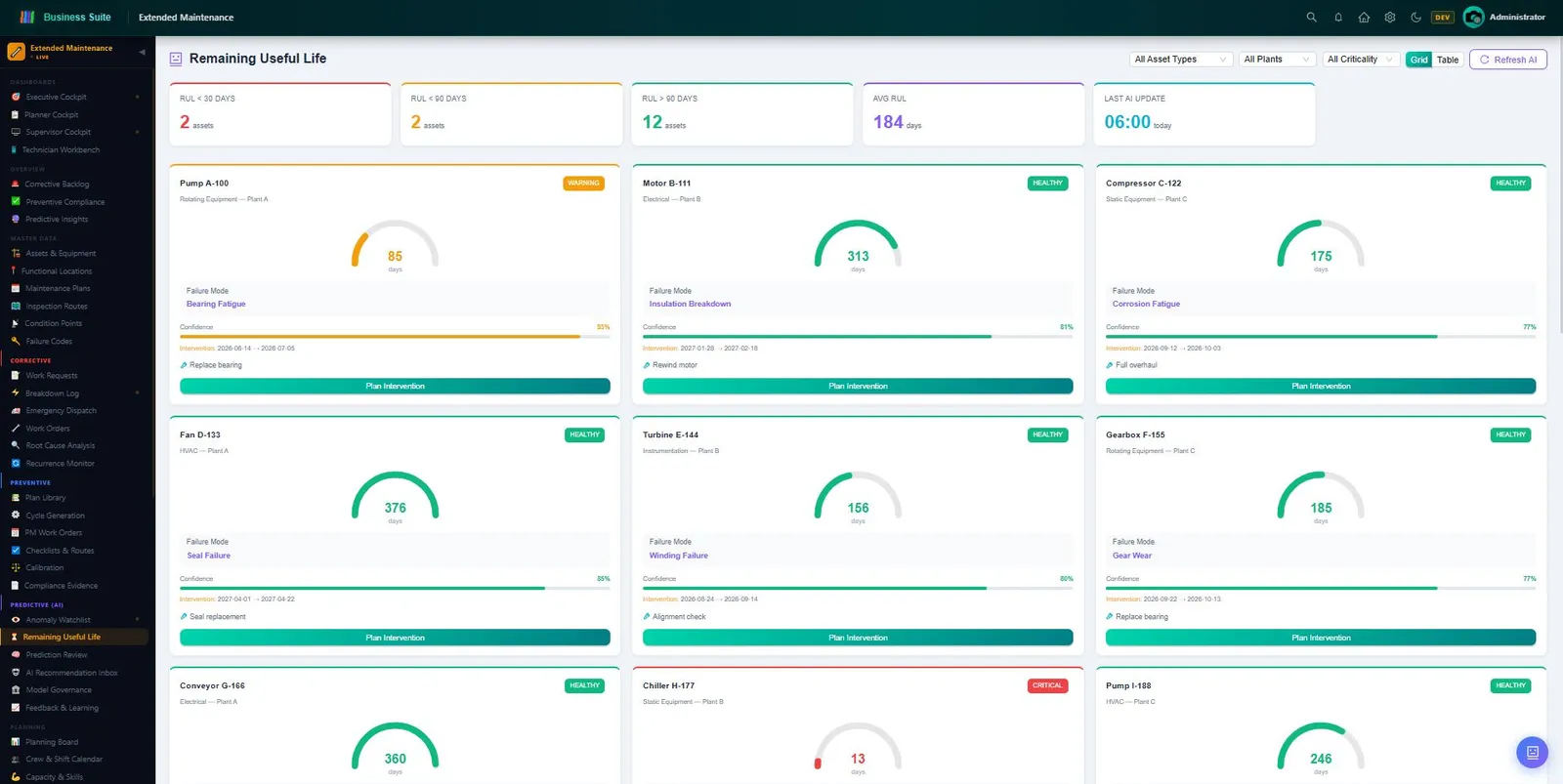
The `maint.ai.recommendation` model is the operational output of Cortex AI's inference pipeline — where probabilistic predictions become structured, auditable, actionable maintenance intelligence. This is not a notification system. It is a governance framework for AI-generated maintenance decisions. Every recommendation generated by Cortex AI is captured with full explainability: the asset it concerns, the predictive model that generated it, the recommendation type (Anomaly Detection, Failure Risk, Remaining Useful Life alert, Optimal Intervention Window, or Grouped Maintenance Optimization), the confidence score (0–100%), the severity classification (Critical, High, Medium, Low), the estimated failure probability (%), the estimated days to failure, the business impact estimate (financial cost of acting-on versus ignoring), the intervention window (the date range during which scheduled maintenance would be most cost-effective), and a natural-language explanation generated by the Cortex language model explaining what specific physical signatures drove the prediction. This recommendation flows into a structured review workflow. The Predictive Reviewer role — a dedicated security role in the maintenance module — receives the recommendation for evaluation. The reviewer can approve it (accepting the AI's assessment and authorising conversion to a work order), reject it with documented reasoning (feeding back to the model accuracy tracking system), or mark it with an outcome label (Correct Prediction, False Positive, False Negative, Too Early, Too Late) after the fact. This feedback loop is not cosmetic — it is the continuous learning mechanism that refines Cortex model accuracy over time, making the system smarter with every production cycle. Critical and High severity approved recommendations are automatically converted to predictive work orders with high priority, directly referencing the AI recommendation, pre-populated with the asset, the predicted failure mode, and the estimated intervention dates. The technician who executes that work order knows precisely what Cortex AI found, why the intervention was triggered, and what to look for.
Reliability Engineering: The Mathematics of Equipment Longevity
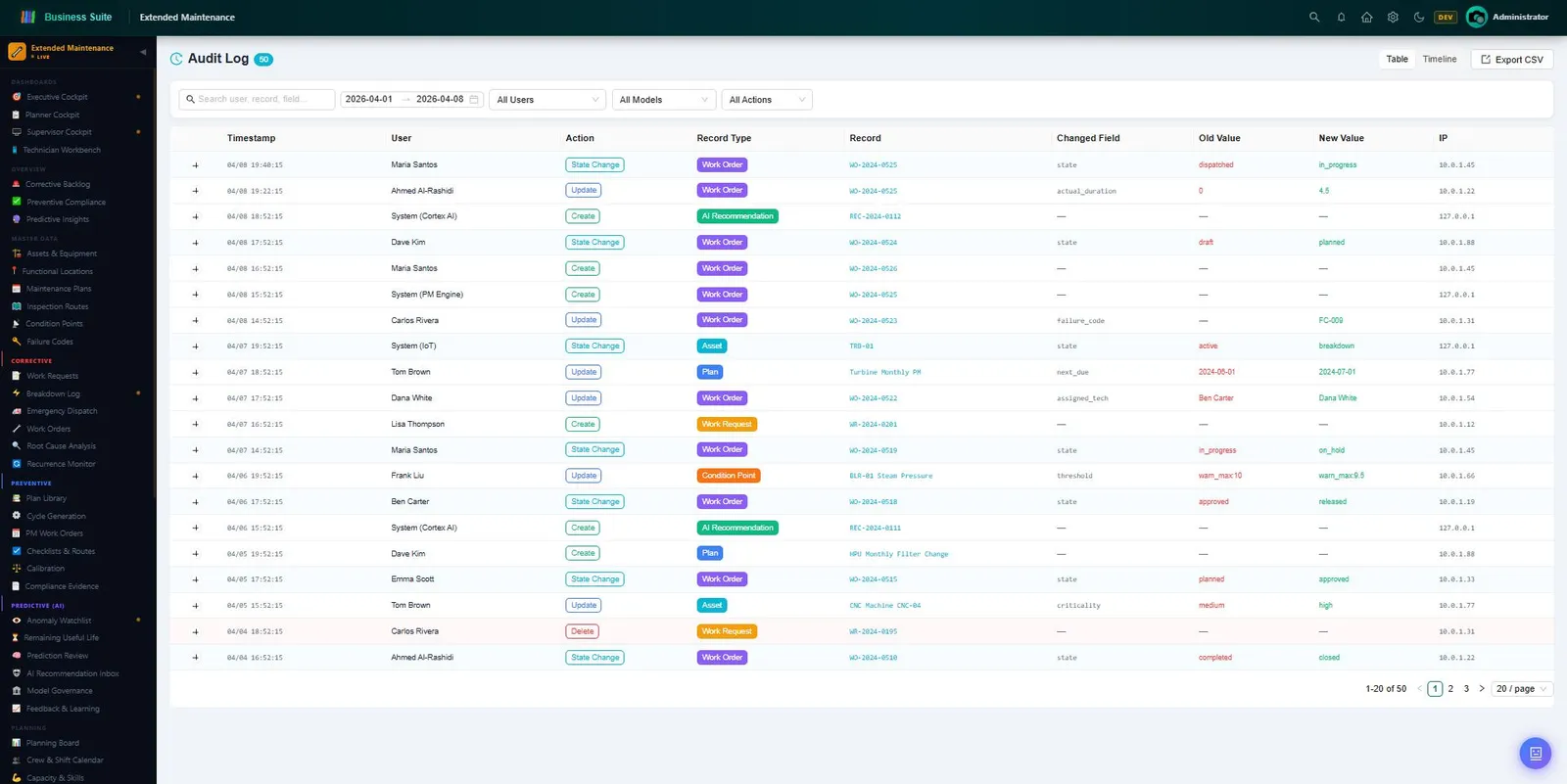
Reliability engineering is the discipline that bridges operational maintenance execution with asset lifecycle strategy. It answers questions that no individual work order can answer: Which assets are chronically problematic? Is our MTTR improving over time? Are our preventive maintenance intervals optimally set? Which failure modes are driving the most downtime cost? Business Suite Extended Maintenance provides a complete reliability engineering toolkit, and it is deeply integrated with the operational maintenance layer — not bolted on as an afterthought analytics module. The `maint.reliability.record` model maintains a live, auto-refreshed reliability profile for every asset in the fleet. The daily cron re-calculates three fundamental reliability KPIs from raw operational data: **Mean Time Between Failures (MTBF):** Calculated as (8,760 hours − total_downtime_hours) ÷ total_failures. This operating-hours-based calculation correctly accounts for the fraction of the year the asset was actually running, rather than naively dividing calendar time by failure count — a critical distinction that most CMMS implementations get wrong. **Mean Time To Repair (MTTR):** Calculated as total repair hours (sum of actual_duration from all corrective work orders on the asset) ÷ total_failures. This gives an empirical, work-order-sourced repair time estimate — not a theoretical estimate from a manufacturer's service manual. **Availability (A%):** Calculated as Operating Hours ÷ (Operating Hours + Downtime Hours) × 100. This is the asset-level availability metric that feeds directly into OEE (Overall Equipment Effectiveness) calculations when integrated with the production management layer. The **Bad Actor Algorithm** deserves specific mention. An asset is automatically flagged as a Bad Actor when either: its total failure count exceeds 5 within the tracking period (indicating systemic reliability problems), or its MTBF falls below 720 hours (30 days). Bad Actor flagging drives automatic escalation to the Reliability Engineer role and triggers a mandatory FMEA review cycle — turning empirical failure data directly into structured reliability improvement action.
FMEA Integration: Closing the Loop Between Failure and Knowledge
The Failure Mode and Effects Analysis (FMEA) module elevates Business Suite Extended Maintenance from a operational tool into a reliability engineering discipline platform. FMEA is the structured methodology by which reliability engineers systematically document every known failure mode for each asset, assess its severity (impact on operations if it occurs), its occurrence frequency (likelihood it will occur), and the detectability of the failure mode (probability that existing controls will detect it before it causes harm). The resulting Risk Priority Number (RPN = Severity × Occurrence × Detection, each on a 1–10 scale) provides a risk-ranked list of failure modes that drives maintenance strategy decisions: high-RPN failure modes warrant predictive monitoring coverage, condition-based maintenance plans, and potentially design-out engineering changes. Low-RPN failure modes may be safely managed by run-to-failure strategy. Business Suite Extended Maintenance implements the full FMEA workflow — from failure mode documentation through RPN calculation to recommended action tracking and action outcome capture. Critically, the FMEA is directly linked to the AI recommendation system: Cortex AI's predictive models prioritise monitoring of high-RPN failure modes and use FMEA-derived feature sets to guide anomaly detection model training. This creates a feedback loop where engineering knowledge informs AI model design, and AI model outputs refine engineering knowledge — a virtuous cycle of continuous reliability improvement.
The Complete Work Order Ecosystem: Enterprise-Grade Execution Management
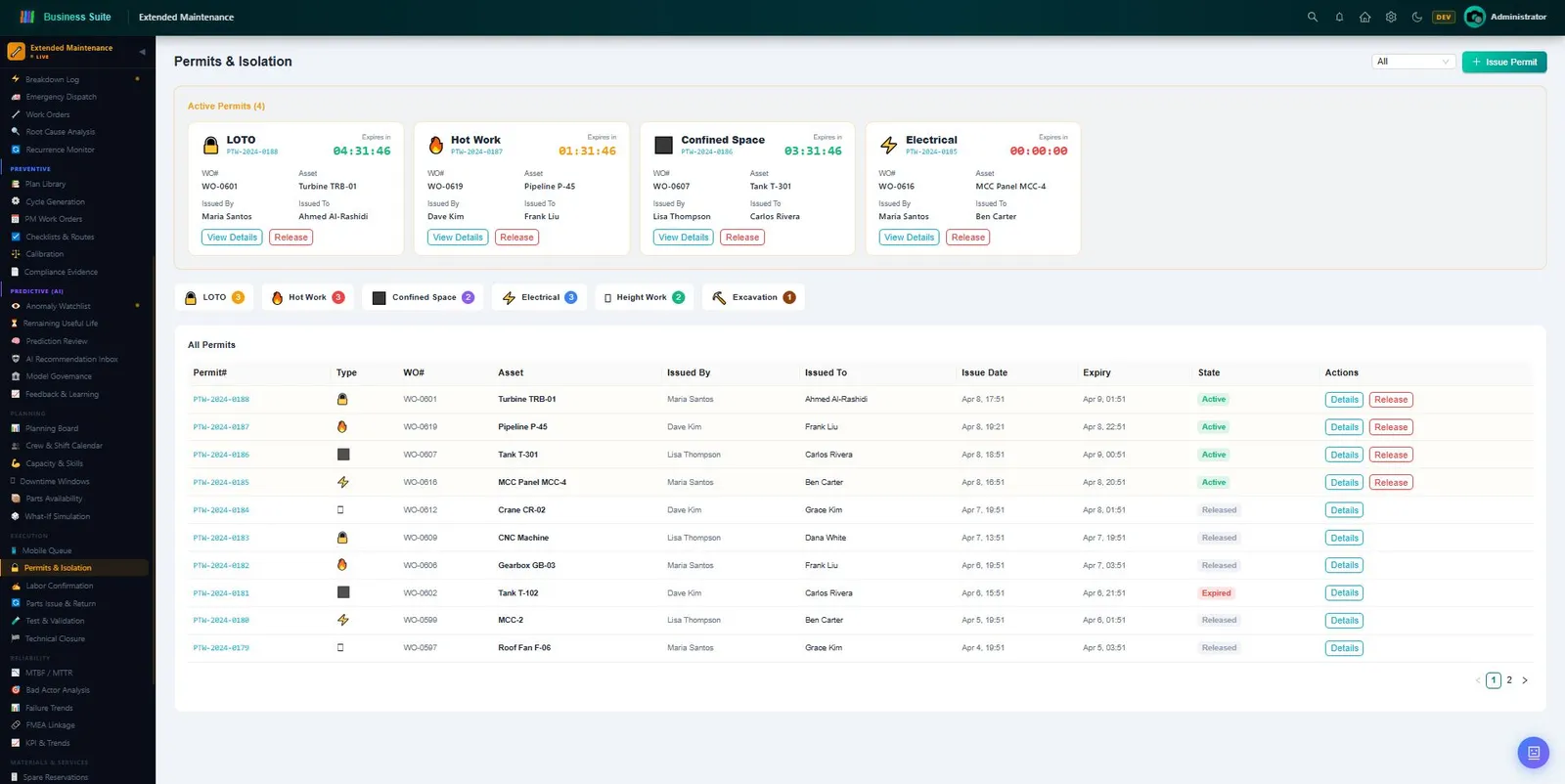
A predictive recommendation is only as valuable as the execution system that acts on it. Business Suite Extended Maintenance provides a work order management infrastructure that matches the sophistication of its predictive intelligence layer in every respect. The work order data model is designed for precision and accountability. Each work order carries a maintenance type classification (Corrective, Preventive, Predictive, or Improvement), a five-level priority rating (Low through Emergency), a full asset and functional location context, a multi-step operation list with technician assignment, estimated and actual duration capture, measurement capture with target/tolerance validation, and safety notes at the operation level. Labor bookings capture time by technician with labor rate and activity type (Regular, Overtime, Contractor, On-Call), yielding exact labor cost for every work order. Spare part reservations track part number, quantity reserved, quantity consumed, unit cost, and status (Reserved, Issued, Consumed, Returned) — giving the stores officer and the maintenance planner complete visibility into parts consumption and inventory impact. The Permit to Work sub-system integrates six permit types — LOTO (Lockout/Tagout), Hot Work, Confined Space Entry, Electrical Isolation, Height Work, and Excavation — with a full permit lifecycle (Draft → Issued → Active → Released). No work order with a permit requirement can transition to Released state until all required permits are in Issued state. This is not a checkbox — it is an enforced, auditable safety gate that protects both personnel and regulatory compliance. Work requests provide the demand intake channel. Any operator, inspector, or external system can raise a work request against any asset. Work requests carry a request type, priority, description, failure code, and source classification (Operator Report, Sensor/IoT trigger, Inspection finding, API call, Manual, or AI Predicted). The source classification creates complete traceability from the initiating event to the closed work order — enabling analysis of what proportion of maintenance demand is being driven by proactive channels versus reactive ones over time.
How Business Suite Compares Against the World's Leading CMMS Platforms
The enterprise CMMS market is dominated by a handful of well-funded platforms — IBM Maximo, SAP Plant Maintenance (now SAP EAM), Infor EAM, Oracle eAM, Hexagon EAM, and the newer cloud-native players like UpKeep, Fiix, and Limble CMMS. Each has genuine strengths, loyal customer bases, and extensive feature sets built over decades of development. This comparison is not about dismissing those platforms — it is about being honest about where Business Suite Extended Maintenance stands in relation to them, and why we believe it represents a generational advance in the category.
| Capability | IBM Maximo | SAP EAM | Infor EAM | UpKeep / Fiix | Business Suite EM |
|---|---|---|---|---|---|
| Corrective Work Order Lifecycle (8-state) | ✅ Complex | ✅ Complex | ✅ Complex | ⚠️ Basic (4-state) | ✅ Full 8-state + PTW |
| Preventive Plan Types (time/meter/condition/route) | ✅ All types | ✅ All types | ✅ All types | ⚠️ Time/meter only | ✅ 8 types incl. seasonal & compliance |
| Inspection Route Management | ✅ Yes | ⚠️ Limited | ✅ Yes | ❌ No | ✅ Full measurement capture + auto WR |
| IoT Condition Monitoring (native, threshold bands) | ⚠️ Via MAS add-on | ⚠️ Via SAP IoT (paid) | ⚠️ Via Hexagon partner | ❌ No | ✅ Native, 3-band multi-point |
| AI Predictive Models (native, no 3rd party) | ⚠️ IBM Watson (add-on, cloud) | ⚠️ SAP AI Core (separate) | ❌ No | ❌ No | ✅ Cortex AI — sovereign, on-premise |
| AI Recommendation Governance (review/approve/feedback) | ❌ No formal workflow | ❌ No | ❌ No | ❌ No | ✅ Full review workflow + feedback loop |
| RUL (Remaining Useful Life) Prediction | ⚠️ Maximo APM (premium) | ⚠️ Requires SAP APM (premium) | ❌ No | ❌ No | ✅ Included, Cortex-powered |
| FMEA with RPN tracking | ✅ Yes (complex setup) | ✅ Yes (complex) | ⚠️ Limited | ❌ No | ✅ Integrated, AI-linked |
| MTBF/MTTR Auto-calculation (daily cron) | ✅ Yes | ✅ Yes | ✅ Yes | ⚠️ Manual/limited | ✅ Auto-daily, operating-hours based |
| Bad Actor Automatic Flagging | ⚠️ Requires custom report | ⚠️ Requires custom report | ❌ No | ❌ No | ✅ Built-in algorithm |
| Permit to Work (integrated, enforced) | ✅ Yes | ⚠️ Basic | ⚠️ Basic | ❌ No | ✅ 6 permit types, enforced gate |
| Vendor/Contract SLA Tracking with penalties | ✅ Yes | ✅ Yes | ✅ Yes | ❌ No | ✅ Auto SLA breach detection |
| EAM Write-back (asset health/condition sync) | ✅ Integrated | ✅ Native | ✅ Integrated | ❌ No | ✅ Native (bs_eam integration) |
| Deployment Model | On-prem / IBM Cloud | On-prem / SAP BTP | On-prem / Cloud | SaaS only | On-premise sovereign |
| Data Sovereignty (no data leaves your perimeter) | ⚠️ Cloud AI = data leaves | ⚠️ Cloud AI = data leaves | N/A | ❌ SaaS = data in vendor cloud | ✅ 100% — Cortex AI is on-premise |
| Implementation Complexity | 🔴 Very High (6-18 months) | 🔴 Very High (12-24 months) | 🟠 High (6-12 months) | 🟢 Low (weeks) | 🟡 Medium (2-4 months) |
| Total Cost of Ownership | 💰💰💰💰 Very High | 💰💰💰💰 Very High | 💰💰💰 High | 💰💰 Medium (limited) | 💰💰 Medium (full capability) |
The Organisational Architecture: Roles, Permissions, and the Intelligence Hierarchy
A maintenance platform is only as effective as its ability to put the right information in front of the right person at the right time. Business Suite Extended Maintenance implements a ten-role permission model that maps precisely onto the typical industrial maintenance organisation: **Technician** — The field workforce. They see assigned work orders, can update operations, capture measurements, log labor hours, and record breakdown events. They do not have access to planning, reliability analysis, or financial data. **Supervisor** — Manages the day-to-day work queue, approves work orders, oversees active breakdowns, and manages permit workflows. Has visibility into crew labor hours and work order status. **Planner** — Owns the maintenance planning layer. Creates and manages maintenance plans, releases work orders to the field, manages inspection routes, and schedules preventive work. Has full visibility into the forward work schedule and resource demand. **Reliability Engineer** — The analytics-focused role. Has full access to FMEA records, predictive models, reliability records, and condition monitoring data. Responsible for bad actor investigation, FMEA maintenance, and predictive model governance. **Predictive Reviewer** — The dedicated AI governance role. Receives Cortex AI recommendations, reviews them with the full prediction context, approves or rejects them, converts approved recommendations to work orders, and records feedback outcomes for model refinement. **Store Officer** — Controls spare parts. Manages reservations, issues, consumption, and returns. Has direct impact on maintenance cost accuracy and parts availability. **Manager** — Has broad access across all operational data including costs, contracts, and vendor performance. Drives strategic maintenance decisions from the executive KPI dashboard. **Auditor** — Read-only access to all records. Critical for ISO 55001 (Asset Management) compliance audits and internal control reviews. This role architecture is not administrative overhead. It is the information governance framework that ensures maintenance data remains trustworthy, maintenance decisions remain traceable, and the AI feedback loop remains uncontaminated by low-quality inputs.
The ROI Case: Quantifying the Business Impact
The business case for Business Suite Extended Maintenance is not theoretical. It is built on the documented performance of integrated CMMS + PdM programmes in industrial environments, and on the specific technical capabilities that Business Suite brings to each ROI driver: **Downtime Reduction (Primary Driver):** Enterprises transitioning from reactive to predictive maintenance programs consistently report 35–50% reductions in unplanned downtime. For a mid-size manufacturer with $500,000/hour downtime cost and 800 hours of annual unplanned downtime, a 40% reduction represents $160 million in recovered production value per year. **Maintenance Cost Reduction:** The shift from time-based PM to condition-based and predictive maintenance eliminates unnecessary maintenance interventions. Industry benchmarks show 20–30% reductions in total maintenance spend. For an enterprise spending $10 million annually on maintenance, this represents $2–3 million in direct cost avoidance. **Spare Parts Inventory Optimisation:** Predictive intervention windows — knowing that a bearing needs replacement within a 2-week window, not right now — enable planned procurement rather than emergency purchasing. Emergency parts procurement typically costs 3–5× the standard price. Predictive maintenance programs routinely achieve 25–35% reductions in emergency parts spend. **Regulatory Compliance and Safety:** The integrated PTW system, audit trail through mail.thread on every work order and breakdown log, FMEA documentation, and inspection route records provide the evidentiary foundation required for ISO 55001 certification, IEC 61511 functional safety compliance, and OSHA audit readiness. The cost of a single safety incident or regulatory non-compliance event typically far exceeds the entire annual maintenance budget. **Asset Lifetime Extension:** Assets managed through condition-based maintenance programmes consistently demonstrate 20–40% longer operational life before replacement. For capital-intensive assets (large compressors, industrial boilers, CNC machining centres), this translates directly into deferred CapEx of millions of dollars per asset.
The question every industrial enterprise must answer is no longer 'Can we afford predictive maintenance?' — it is 'Can we afford to operate without it?' The data is unambiguous. Enterprises that master the transition from reactive to predictive maintenance do not just reduce costs — they build a structural competitive advantage that compounds over time as their AI models accumulate operational intelligence that their competitors simply do not have.
The Data Sovereignty Imperative: Why On-Premise AI Is Non-Negotiable for Industrial Enterprises
When IBM Maximo Application Suite or SAP Predictive Maintenance and Service processes your vibration spectra, your thermal profiles, your process parameter histories, and your equipment failure patterns in their cloud infrastructure, they are not just providing a service. They are accumulating proprietary operational intelligence about your equipment, your processes, and your production environment — intelligence that, under certain licensing and data residency frameworks, they may aggregate, benchmark, and exploit competitively. For most industrial enterprises — particularly those in defence supply chains, critical infrastructure, regulated utilities, and competitive manufacturing — this is not a theoretical concern. It is an explicit data governance requirement from legal, compliance, and in some cases national security frameworks. Business Suite Extended Maintenance with Cortex AI offers the only answer that addresses this concern without compromise: the AI inference engine runs entirely on-premise, within your security perimeter, on hardware you control. Your vibration signatures, your thermal profiles, your FMEA data, and your AI model parameters never leave your facility. There is no cloud dependency, no data residency risk, no vendor lock-in on operational intelligence. Your predictive maintenance models are your intellectual property — full stop. Furthermore, the on-premise architecture enables Cortex AI to be trained on your specific equipment population, your specific operating conditions, your specific failure history — producing predictive models that outperform generic cloud-trained models precisely because they are calibrated to your operational reality, not to some industry average derived from aggregated customer data.
Conclusion: The Maintenance Platform That Thinks, Learns, and Protects
Business Suite Extended Maintenance is not an incremental improvement on existing CMMS technology. It is a fundamental rethinking of what a maintenance platform should be in the age of industrial IoT and sovereign AI. It masters corrective maintenance — capturing every failure event with structured failure taxonomy, driving systematic root cause analysis, enforcing safety through integrated Permit to Work, and feeding every outcome into a living reliability intelligence corpus. It masters preventive maintenance — with eight plan types, automated work order generation, structured inspection routes with measurement capture, and a daily scheduling engine that ensures no planned intervention is ever missed. It masters predictive maintenance — with native IoT integration across seven condition monitoring modalities, Cortex AI inference via pre-trained and custom-trained models, AI recommendation governance with full review workflow and feedback loops, and automatic conversion of predictions to actionable work orders. And it ties it all together with a reliability engineering layer — MTBF/MTTR calculations, Bad Actor detection, FMEA analysis, and a continuous AI learning cycle — that transforms operational maintenance data into strategic asset management intelligence. For the manufacturing enterprise that is serious about eliminating unplanned downtime, reducing maintenance costs, extending asset life, and building a data-sovereign AI capability that compounds in value with every production cycle — there is no more complete, no more integrated, and no more powerful maintenance platform available today than Business Suite Extended Maintenance. The era of reactive maintenance is over. The era of intelligent, predictive, sovereign maintenance begins now.